Feasibility · Colorado pilot pathway — Wet Mountain Valley context, Westcliffe area
AI Data Centers Reimagined
Computing infrastructure designed as a good neighbor.
“How can data centers become protected, modular, water wise, energy intelligent, beautiful, educational, and regenerative members of their communities?”
Seed Question
The public question
Data centers are being sited faster than communities can form a view about them. The public conversation has settled into two positions — build them because the economy demands it, or block them because they take water, power, land, and give back a handful of jobs. Both positions accept the same premise: that the building is what it is.
We think that premise is the weak point. A data center is a large, capital-rich, thermally active, permanently staffed structure placed in a specific watershed. Almost nothing about its current form is required by physics. It is the product of a procurement culture optimizing for speed and cost per megawatt, and nothing else.
So the question we are working is narrower and more useful than a verdict: what would the building have to become before a community would genuinely want it there?
Why it matters
The next decade will place an enormous amount of new computing capacity somewhere. Where it lands, it will set land prices, water agreements, grid investment, and local politics for a generation. These are effectively permanent decisions being made under time pressure with very little public design work behind them.
Rural western communities are especially exposed. They have the land, the transmission access, and the tax appetite, and they usually lack the technical staff to negotiate as equals. The result is a boilerplate agreement written by whoever arrives with a template.
A single well-documented alternative changes that dynamic more than any amount of opposition. If a county can hold up drawings, costs, water figures, and a measured benefit standard from a comparable project, the negotiation starts from a different place.
Listening Field
Listening field
We are gathering accounts from people who live inside this question already: residents near existing facilities, county commissioners and planners who have voted on them, utility staff, water managers, ranchers whose land borders proposed sites, and technicians who work inside the halls.
What we are hearing so far, and want to hear much more of: noise and light are described more often than water; the jobs question is more contested than the energy question; and almost every community says the same thing about process — they learned about it late.
Open
The listening field for this project is open and will stay open through construction. Contributions are credited by name unless anonymity is requested.
Knowledge Grove
Knowledge grove
We are assembling the technical and regulatory record: cooling and closed-loop water literature, waste-heat recovery precedents in Northern Europe, hydrothermal carbonization research, agrivoltaic and solar-canopy structural studies, microgrid interconnection rules, Colorado water law, and county-level siting agreements already in force.
Every source is listed with its provenance and its limitations. Where studies disagree — particularly on heat recovery economics and on real versus nameplate water use — we record the disagreement rather than choosing the convenient number.
Solution Garden
Solution garden
These are the concepts currently growing side by side. None is settled. Several may not survive the bench.
Solar protective exoskeleton
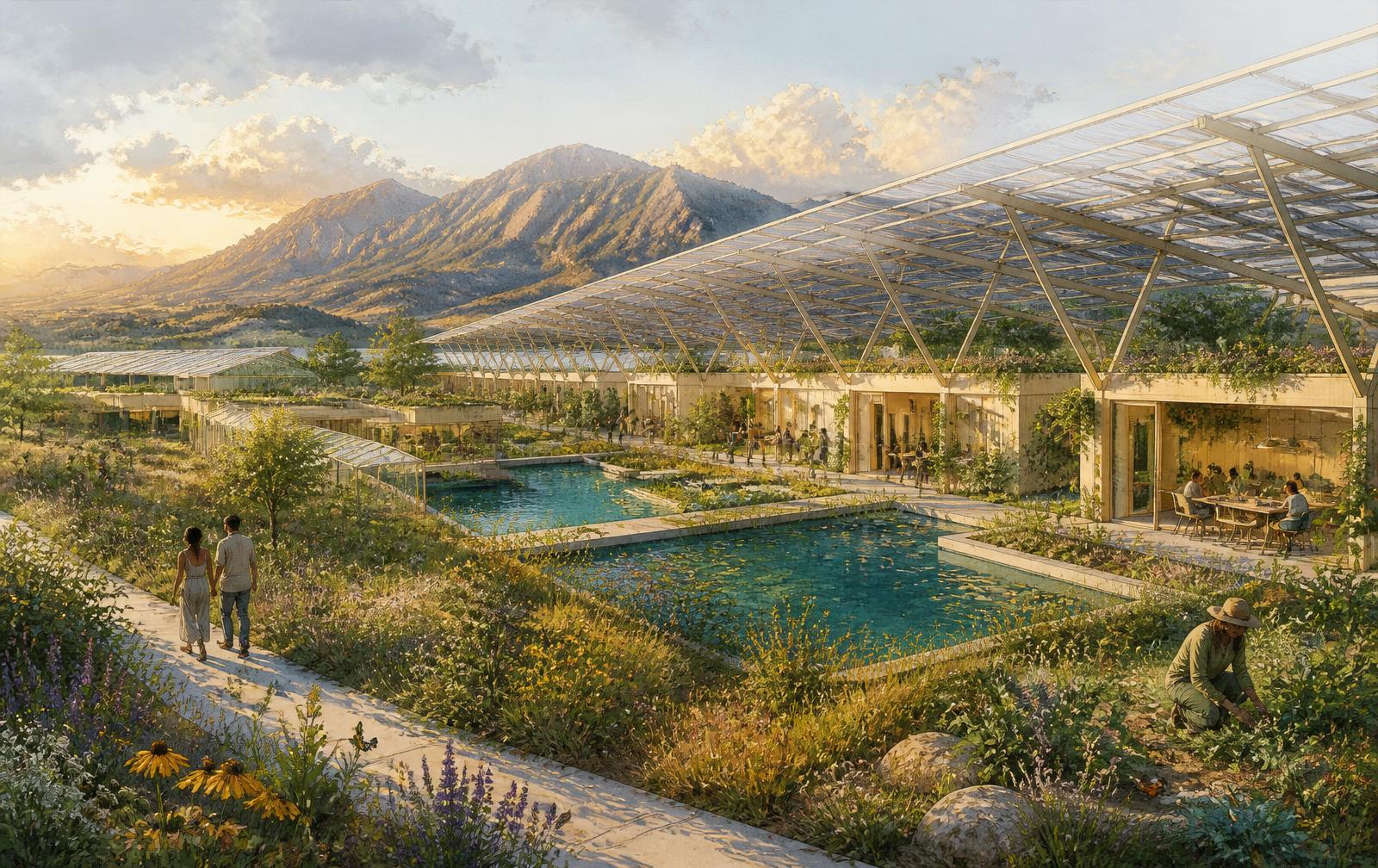
A structural canopy over the halls carrying photovoltaics, shading the envelope, shedding hail and snow, and creating a protected working microclimate underneath. The skin does three jobs instead of one.
Shielded, removable, replaceable systems
Compute, power, and cooling as swappable modules on a service spine, hardened against weather, fire, and physical intrusion. Designed for a twenty-year building holding five-year equipment.
Closed loop water
Recirculating cooling with treatment and storage on site, sized so that normal operation draws minimal makeup water, with metered public reporting rather than estimates.
Heat recovery with a real receiver
Low-grade heat routed to greenhouses, drying, aquaculture, or district loops. Heat recovery only counts if something on the other end genuinely needs it year round.
Community microgrid
Generation, storage, and controls that can support critical local loads during outages, rather than a facility that only draws from the grid it strains.
Food growing
Greenhouse capacity integrated with recovered heat and treated water, operated by a local grower under its own business model, not as landscaping.
HTC and circular waste
Hydrothermal carbonization and related processes explored for on-site organic waste streams, producing soil amendment and reducing haul-off.
Habitat and land
Native meadow, pollinator corridors, dark-sky lighting, and acoustic buffering treated as design requirements with measurable targets.
Education
A public room, a viewing gallery, instrumentation displayed openly, and standing apprenticeship placements for regional students and trades.
Measurable community benefit
A benefit standard written in units — kilowatt-hours shared, acre-feet returned, apprenticeships filled, therms of heat delivered, dollars kept regional — reported publicly on a fixed schedule.
Feasibility Bench
Feasibility bench
This is where the project sits today. The bench work underway covers structural cost of the canopy against its energy and durability return; realistic closed-loop makeup water at Colorado altitude and humidity; the honest economics of low-grade heat when the receiver is seasonal; interconnection and tariff treatment for a microgrid that exports; and the permitting path through county land use and state water administration.
Two assumptions are currently the most fragile, and we are saying so plainly: whether heat recovery pays for itself without a subsidy, and whether a canopy structure survives cost review against conventional roof-mounted arrays. If either fails, the design changes rather than the claims.
Project Nursery
Project nursery
We are forming the founding team and seeking partners: a mechanical and water engineering firm, a utility or rural electric cooperative willing to co-design interconnection, a landowner or county open to hosting a study site, a grower interested in operating greenhouse capacity, and funding for a rigorous feasibility study rather than a rendering.
Governance is being drafted under cooperative principles through Harmony Development Cooperative, so that the community hosting a pilot holds a real and durable stake in it.
Living Pilot
Living pilot vision
The intent is a modest first facility in Colorado — small enough to build honestly, instrumented thoroughly, and open to visitors. Not a showcase. A working building whose numbers are published whether or not they flatter the design.
If it works, the useful output is not the building. It is the drawing set, the cost record, the measured performance, and the benefit agreement — released openly so the next county has something to negotiate with.
What this project needs
Specific help, honestly stated.
These are the gaps that would move the work forward this year.
Engineering review
Mechanical, structural, water, and electrical practitioners willing to stress-test the bench assumptions.
Utility and county conversation
Introductions to rural electric cooperatives, planners, and water administrators open to early dialogue.
A study site
A landowner or public entity in Colorado willing to host feasibility work and, potentially, a first pilot.
Feasibility funding
Support for a genuine study — surveys, modelling, and independent review — published in full.
Local voices
Residents near existing or proposed facilities willing to describe their experience for the record.